The project was supported by EIT Health, one of Europe’s largest public-private partnerships dedicated to healthcare innovation. As a Knowledge and Innovation Community (KIC) of the European Institute of Innovation and Technology (EIT), EIT Health is funded by the European Union and operates through a pan-European network, including leading universities, research institutions, healthcare providers, and industry actors.
EIT Health’s mission is to improve the health and well-being of European citizens by accelerating innovation, fostering entrepreneurship, and strengthening education in the healthcare sector. It operates at the intersection of the so-called “knowledge triangle”: education, research/innovation, and business creation.
A central pillar of EIT Health is its Education portfolio. Through a wide range of programmes (including degree programmes, professional training, fellowships, summer schools, and online learning formats), EIT Health equips professionals and practitioners with the skills needed to address complex health challenges.
EIT Health operates through a competitive funding model based on annual calls for proposals aligned with its strategic priorities. Projects are typically collaborative and must demonstrate clear societal and economic impact, particularly in addressing key challenges. Funding is often provided as “top-up” support to complement existing projects, helping to advance, scale, or commercialize results at the European level.
Financially, EIT Health combines EU funding (via the EIT and programmes such as Horizon Europe), partner contributions, and additional public and regional investments. This model aims for long-term sustainability while leveraging co-investment from its network. Importantly, a significant share of its budget is dedicated directly to operational activities, including education, innovation projects, and business creation, ensuring tangible impact across Europe.
This project was funded within the framework of EIT Health’s Education activities, reflecting its commitment to advancing high-quality, innovative learning formats that strengthen Europe’s healthcare workforce and innovation capacity. By supporting interdisciplinary collaboration and knowledge transfer, we contributed to building a more resilient, inclusive, and future-oriented healthcare system.
Co-Creation Activities
Co-Creation Activities in Developmental Stages of the Massive Open Online Course (MOOC)
The initial project goal of the project “PsyHealth worXs! Psychosocial Health Prevention and work standards” was to develop a user-friendly, practically oriented Massive Open Online Course (MOOC) on edX. The project involved participation of executives and practitioners in the field of occupational safety and health in two co-creation workshops. The co-creation activities were conducted to assess the needs of practitioners concerning the understanding of psychosocial risks (“What are they in specific?”) and the conduction of a psychosocial risk assessment (“Which steps do they specifically have to take?”). The group activities of the needs assessment were directly implemented into the MOOC content.
Co-Creation Activity Maastricht
The first workshop took place at Maastricht University on January 20, 2020. Twelve participants with different positions, such as human resource manager, health and safety officer, and manager, were present. The moderators of the workshop were Professor Ute Hülsheger and Vera Lemmens from Maastricht University. Professor Jessica Lang, Roman Pauli, and Lisa Auweiler from University Hospital RWTH Aachen were participating.
The workshop started with an introduction round, where participants were asked about their experience with psychosocial risk assessment. All of them had some prior experience with PRA, and some already indicated that they experienced it as a difficult process. For example, they explained that they did not receive enough support from all stakeholders, or the organisation did not consider implementing preventive measures necessary, but only intervened when there was an acute need for action. After the introduction round, we presented our ideas for the MOOC within the framework of the risk assessment cycle. We discussed the need for psychosocial risk assessment and gave an impression of the content of the MOOC, as well as the structure of the course.
Next, we asked for input from the participants. They were asked the following questions:
What are lessons you learned and challenges you faced when conducting psychosocial risk assessment?
What do you need in order to conduct a psychosocial risk assessment (knowledge, tools, and support)?
What would the MOOC need in order to help you conduct a successful psychosocial risk assessment?
Which steps of psychosocial risk assessment would you like to receive information on most?
Which additional suggestions do you have for the MOOC?
The participants indicated, for example: The tool should be easy to follow for people without prior experience with psychosocial risk assessment; It should explain how you can evaluate assessment instruments; It should include specific examples of interventions and how to implement them; They would like to receive tips on how to engage employees in psychosocial risk assessment and how to communicate about psychosocial risks in the company; It should be time-efficient, as people need to be able to do this next to their regular working tasks.
Co-Creation Activity Aachen
The second co-creation activity took place in Aachen on January 29, 2020. 32 participants from different professions, such as medical specialists and occupational health psychologists, were present. The co-creation activity was part of the event series Arbeitsmedizinisches Kolloquium at the University Hospital in Aachen. The topic of the event series in general is latest research in occupational health medicine. The topic of this event was “psychosocial risk assessment” and it was moderated by Professor Thomas Kraus as the head of institute and the University Hospital, Professor Jessica Lang as project lead, and Dr. Andreas Tautz as Chief Medical Officer and member of our project advisory board.
The workshop started with a welcoming and an introduction by Professor Kraus. Afterwards, Professor Lang reported latest research findings and numbers about the psychosocial risk assessment in German and European companies. Then there was an interdisciplinary case discussion and needs analysis conducted in an interactive way with the participants of the event. Participants discussed the same questions as in Maastricht and furthermore, they were asked to fill out story cards with several questions.
As a (responsible person in occupational health and safety), I expect the following from the content of the MOOC...in order to...
As a learner, I expect the following from the design of the MOOC...in order to...
Some of their comments included: It is important to make the distinction between stress and strain clear; The MOOC should be accessible from home and for everybody; It should explain how to prepare for the psychosocial risk assessment; It should include information on how to document the process in a good manner; To approach a broader audience in Germany, it should be made available in German.
The event ended after a subsequent discussion with exchange of experiences, where all participants could ask questions, share thoughts, and give input. The interested participants could write down their contact details for further information on the course launch date.
Needs Assessment
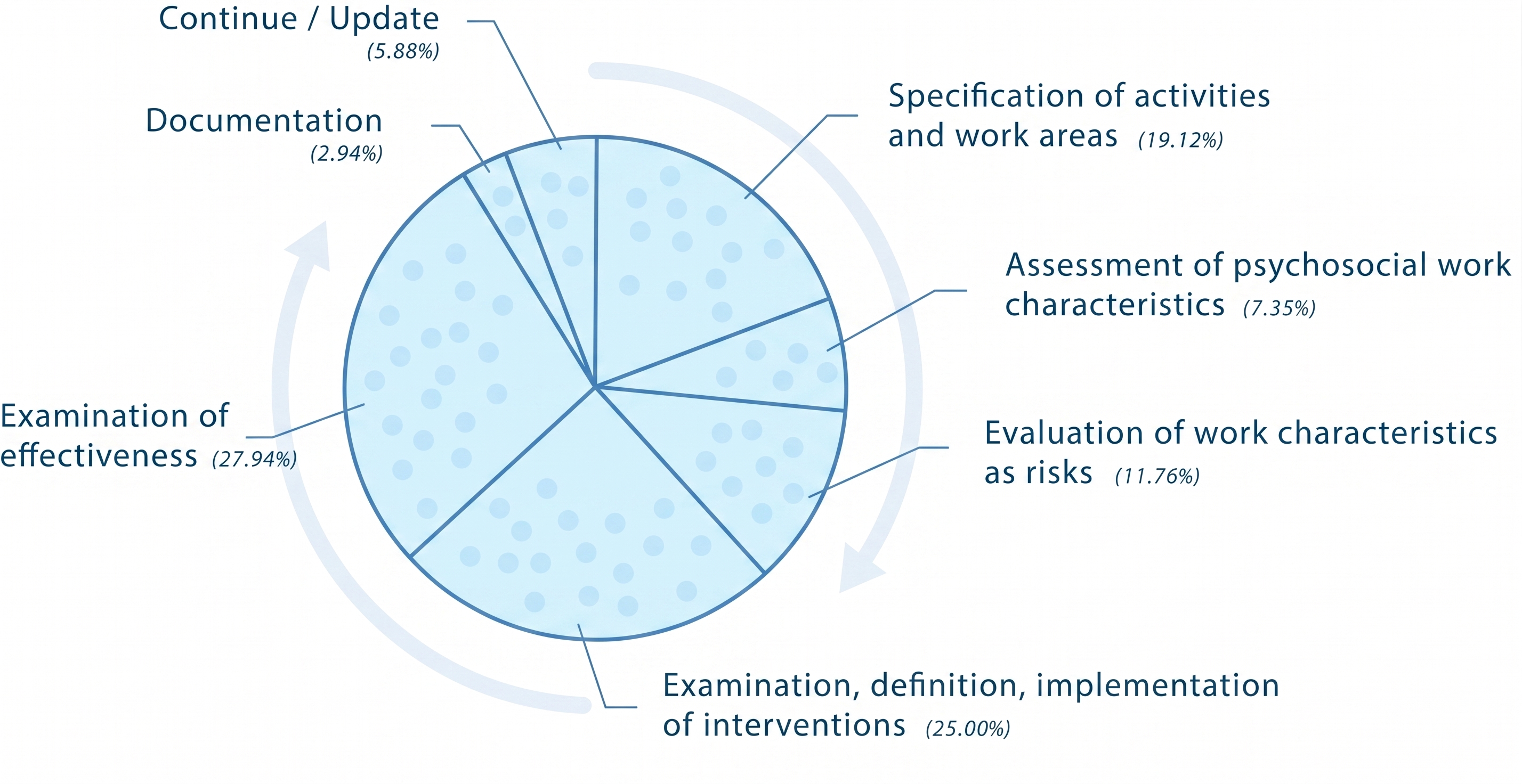
The needs assessment shows the seven steps of a psychosocial risk assessment and the percentage of participants who reported difficulties in conducting the steps (multiple answers possible).
Co-Creation Activities in Developmental Stages of the Serious Game (SG)
In December 2021, an online meeting with all project partners and their staff was the start of the SG development. It included important preparatory steps and planning the co-creation activities with the advisory board. With the beginning of January 2022, a weekly meeting with an interdisciplinary team of researchers (Germany, Netherlands, Spain) and game developers (Spain) was implemented and was maintained for most of the year. The first meetings revolved about organisational matters as well as requirements, tasks, and timetables. In the latter meetings, the team discussed and focused on content-related, structural, and technical matters.
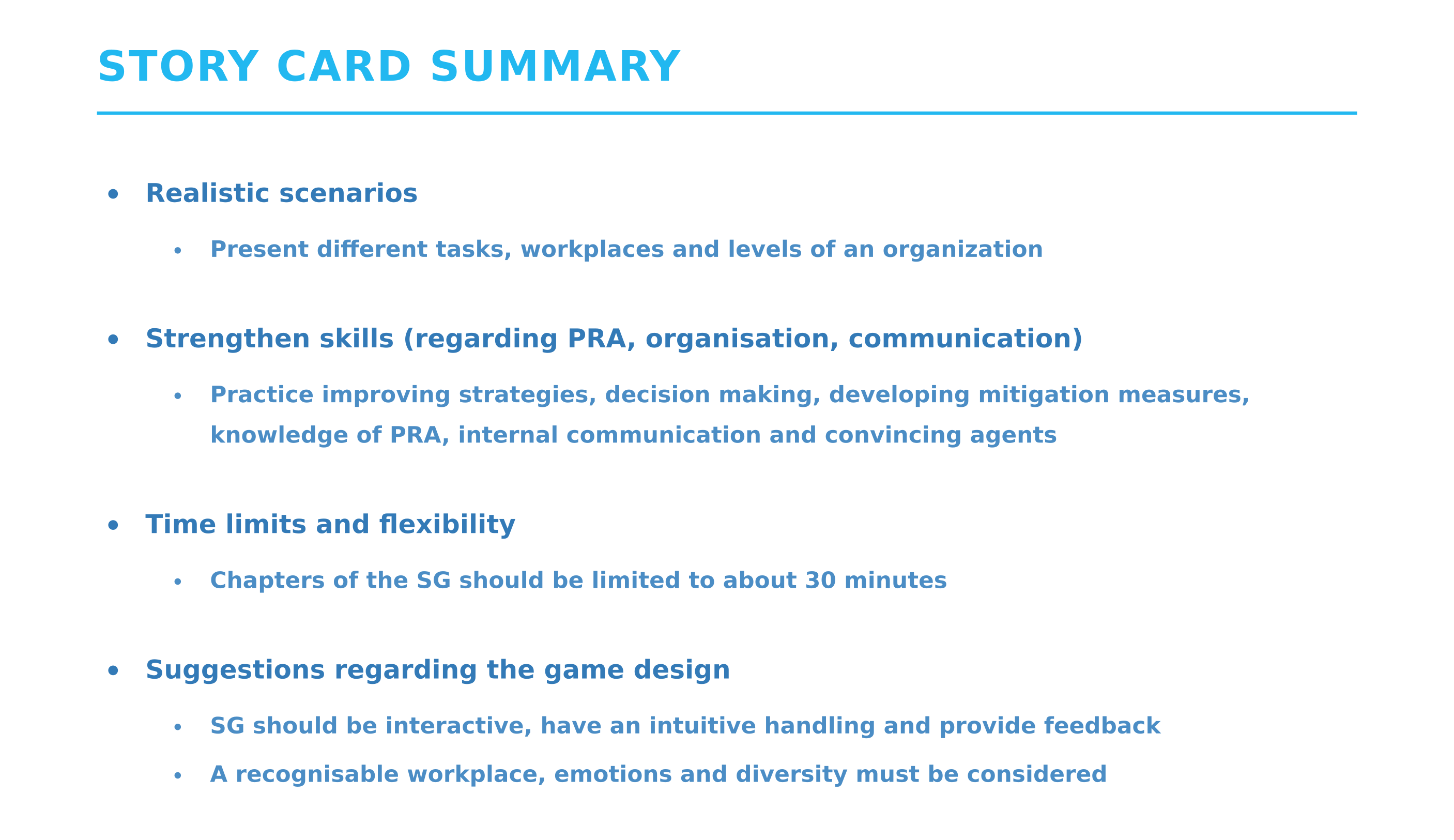
The co-creation activities with an advisory board started with invitations in early January 2022. It consisted of practitioners from the field of occupational health experienced in conducting psychosocial risk assessment. In the first quarter of 2022, two online meetings with the advisory board provided deeper knowledge and insights about practical requirements and preferences from the practitioners and experts for a virtual learning environment by using story cards. The information resulted in important key components as well as in general conditions for planning and realizing the final SG.
Results of the story cards of the advisory board in the SG development
Past Events
Continuous Events
From 2021 ongoing: Within the PsyHealth worXs! Course on edX, Meet the instructors offered a learner engagement event online. Learners in the instructor-paced course were offered the opportunity to ask their most burning questions to the course instructors so that they were able to prepare the online session to discuss the specific problems together.
2022-2024: On a yearly basis, PsyHealth worXs! was advertised at the DoCare Online congress. This event represents a quality circle for leadership training but has all OSH stakeholders involved as participants. The last presentation was on November 11, 2024.
Single Events
On May 10, 2022, Prof. Lang was invited to hold a session about “Mental Health and Prevention at Work” with leaders and OSH specialists of a large German municipality were participants were able to gain knowledge and insights on the MOOCs topic focussing on a scientific perspective as well as its best practice application to daily work.
On June 3, 2022, Prof. Lang participated in the Healthy Work Summit Siemens in Munich, Germany and discussed “Psychological demands and Occupational Safety from a scientific perspective” with leading occupational health experts in German companies.
On May 12, 2023, Prof. Lang participated at the 21st Northbavarian Forum for “Health and Safety at Work” in Erlangen, Germany. The forum is an accredited further education event for occupational physicians from the Bavarian Medical Association, where she was invited to discuss the topic of “Psychosocial Risks”. Within that session, participants had the chance to gain new insights specifically about the topic how to evaluation psychosocial demands as risks.
On September 20, 2024, the German course instructor hold a seminar on “stress prevention at work – preventive actions” specifically for leaders in university settings at the “Quellpunkt RWTH Aachen”
On November 27, 2025, Prof. Lang held a workshop at her Institute with PhD students and their supervisors from across Europe during the MuSIC (Multi-sensory solutions for increasing human-building resilience in face of climate change) Training Week in Aachen. Participants had the chance to deepen their understanding of Psychosocial Risk Assessment by conducting one for their own jobs as students and supervisors and discuss potential measures.
Development Process
The initial goal of the 2020 project was to create a scientifically-based and practice-oriented course. Therefore, the first step was to study the literature on work stress, psychosocial risks, and psychosocial risk assessment. In this section, you can find information on the framework on which the Massive Open Online Course (MOOC) “PsyHealth worXs!” is based.
First Steps of the Project: MOOC Creation
A MOOC generally consists of several elements: short videos, complementary information, assignments and quizzes, and supplementary material. To generate all this material, we broke it down into smaller steps.
First, we assembled the content for the lecture videos. We wanted the content to be based on both literature and the needs of our target group. Therefore, our first steps were to study the literature, and to organise co-creation activities with practitioners from the field of occupational safety and health in Maastricht, Lisbon, and Aachen.
The next step was to take the literature and input from the practitioners and write a script for the course videos. Next to this, additional course content was created, such as written information and assignments and quizzes. After the script was done, an experienced TV journalist/presenter reviewed our material and gave feedback to improve the script. Furthermore, she gave a presentation training to the presenters of the MOOC videos.
The next step was to film the videos of the MOOC. Additionally, expert interviews were conducted to add to the content videos of the training. Finally, additional supplementary material, such as legal guidelines for the different countries involved, was created.
MOOC Script
The framework of the script was based on the seven steps of psychosocial risk assessment. This is derived from the GDA (Joint German Occupational Safety and Health Strategy)’s programme to "Protect and strengthen health in the event of work-related psychosocial factors" and from The European Framework for Psychosocial Risk Management (PRIMA-EF) project (Leka, Cox, & Zwetsloot, 2008).
The first step in devising the script was to create an outline for the MOOC, based on the seven steps of psychosocial risk assessment, with the feedback from the co-creation activities in our mind. Each course week would be dedicated to one step of the psychosocial risk assessment process. Next to this, based on the needs of the participants in the co-creation workshops and to make the course as complete as possible, other information was included as well. For example, information about work-based stress, terminology used in psychosocial risk assessment, EU legal guidelines on psychosocial risk assessment, and obstacles one could encounter in the process.
We made a rough division of the information over videos of about seven to ten minutes. Then, we started adding more information from the literature and examples to each step of the cycle. We also talked to experts in the field from our advisory board, to confirm that our examples were realistic. After we decided which information would be included in each of the videos, it was time to start writing the actual script. We would work with a teleprompter, on which the text of the script is shown when the presenter is filming the videos. Therefore, we wrote the script verbatim. Several feedback rounds within the team were introduced in the process of creating the script.
The Slides
In the videos of the MOOC, slides are shown next to the speaker. These slides were prepared in advance as well. Research has indicated that showing slides next to the speaker is more engaging than showing slides alone (Guo, Kim, & Rubin, 2014), therefore the slides were created with the purpose of being complementary to what the speaker was saying. We wanted them to support the speaker, without being too distracting for the learners. We created slides with keywords, images, and figures. We created the figures ourselves and they mainly show research findings. Afterwards, our project partner AVMZ (audio-visual media center) of the University Hospital at RWTH Aachen University retouched the slides and made sure they fit with the goals and aesthetic of the MOOC.
Course Text
A MOOC does not solely consist of videos. There are also sections with texts, quizzes, and supplementary material. These had to be prepared as well. For example, we wrote introductory texts for each chapter and subsection, and more general information on the course, such as time investment, objectives of the course, and information about certificates. This information was necessary for the course platform on edX.
Quizzes and Assignments
Furthermore, MOOC videos are typically followed by rehearsal quizzes, in which learners can test their knowledge. Some of these questions are available to all learners, while others are only available for learners in the certified track who will obtain a certificate for successful course participation. Different types of quizzes are included, such as multiple choice questions, true or false questions, and drag-and-drop exercises.
We had to design these questions and make sure to have a balance between difficult ones, and ones that were less complicated. Moreover, for the learners who desire to obtain a certificate, we created extra assignments. Two essay questions were designed, in which the learners are asked to apply their knowledge to a new context, preferably to their own organization. To give the learners the opportunity to learn from each other and make the MOOC as self-maintaining as possible, we included peer-reviews as the main method of evaluation of the assignments. To this end, we developed an evaluation key which helps the learners correct the assignments of their peers. In this key, we included evaluation criteria and indicators of possible correct answers. Overall the learners for the verified track had to answer 17 questions and prepare two assignment as well as peer-review three assignments of other learners.
Filming Videos
The next step was to film the actual videos. Research has shown that a ‘talking head’ is more engaging than solely PowerPoint slideshows, probably because it feels more intimate and personal, and is less monotonous (Guo, Kim, & Rubin, 2014). Therefore, for all videos, shots which include the presenters were filmed in the studio of AVMZ in the university hospital Aachen. Several days were spent filming the videos. The lecture-style videos were filmed in AVMZ’s studio. All videos that included concrete workplace examples for psychosocial risks or interventions were filmed on site: in an office, a hospital, and a manufacturing site. For these videos, actors were hired who played the parts of office workers, hospital staff, patients, and manufacturing workers. The research team was also present when these shots were filmed, to ensure that the ideas we had in mind were also depicted in the videos, and to give directions to the actors and film crew. Filming the actor scenes was one of the biggest challenges during the Corona pandemic, since the scenes were outside the university hospital at different locations so that the admission to the settings was partly restricted. All filming outside the AVMZ studio was also used for developing the trailer.
Parallel to filming the videos, AVMZ started cutting and editing the videos. Several feedback rounds were implemented, in which the research team first checked the raw cuts of the videos and provided feedback. In a later stage, AVMZ created a specific design and logo for the project. The green-screen background, text, and PowerPoint slides were adjusted to follow this design. Several feedback rounds were administered to perfect the layout.
Expert Interviews
Next to the videos about the seven steps, we also invited experts on psychosocial risk assessment to interview them about their experiences. We interviewed several occupational and organisational psychologists, occupational physicians, and occupational safety specialists who are experienced in the field of OSH in the EU. Due to the COVID-19 pandemic, all interviews were carried out and recorded via Zoom. Our aim was to share different opinions and experiences on a range of topics. To this end, we asked the interview partners the questions about the topics they were most experienced on and compiled their answers in several expert interview videos. Each video addresses a different topic, such as obstacles to psychosocial risk assessment, examples of interventions in practice, and general tips for psychosocial risk assessment. Some interviews were included in the content videos, others were provided within the course as supplements in the respective section “Let’s hear what experts and practitioners think”.
AVMZ realized that the self-administered Zoom recording followed the design structure of the overall course.
Supplementary Material
Furthermore, to make the MOOC as complete as possible, we prepared several checklists, more intervention examples, and useful websites for those who want to learn even more about psychosocial risk assessment. Next to this, as the course is available in several countries, we included country-specific information, such as legal guidelines and useful websites, for Germany, the Netherlands, and Portugal in the partner countries respective native language (i.e. Dutch, German, and Portuguese). AVMZ provided a template that offered to integrate the supplements within the corporate design of the project.
Subtitles
To make sure the MOOC is inclusive for as many learners as possible, we transcribed all the videos in English. Furthermore, to increase the reach of the MOOC, we created additional subtitles in three languages: German, Dutch, and Portuguese. In this way, the course is subtitled in all the languages of the different project partners: RWTH Aachen University, Maastricht University, and University of Lisbon and available throughout Europe due to the English language.
Discussion Forum
Furthermore, some additional elements were added to the course. Research suggests that interactivity increases the quality of learning (El-Hmoudova, 2014), therefore we found it important to include interactive elements in the course. Next to this, we wanted to give the learners the opportunity to not only learn from us, but also from each other. Hence, we created options for learners to exchange thoughts and ask questions in the discussion forum every week. Furthermore, research found that interaction of learners with MOOC instructors predicts MOOC retention (Hone & El Said, 2016). To this end, we prepared stimulating questions at several points throughout the MOOC and made sure that one of our course members interacted with and answered questions from learners of the MOOC every day from Monday through Friday.
Icons generated by Storyset (https://storyset.com)